How to Estimate Body Fat Percentage (Methods + Accuracy)

Estimating body fat sounds like it should be straightforward. You plug in a few numbers, get a percentage, and move on. In reality, it’s one of the most confusing fitness metrics people deal with — not because it’s useless, but because it’s often misunderstood.
The reason body fat metrics feel frustrating is that there is no single “correct” number floating inside your body waiting to be discovered. Every method — calculators, tape measurements, smart scales, scans, photos — is an estimate. Each one uses different signals, assumptions, and tradeoffs. Disagreement between methods isn’t a failure. It’s the expected outcome.
The goal isn’t to chase a perfectly precise percentage. The goal is to use body fat estimates to understand your body better, interpret changes realistically, and choose tracking methods that actually help you over time.
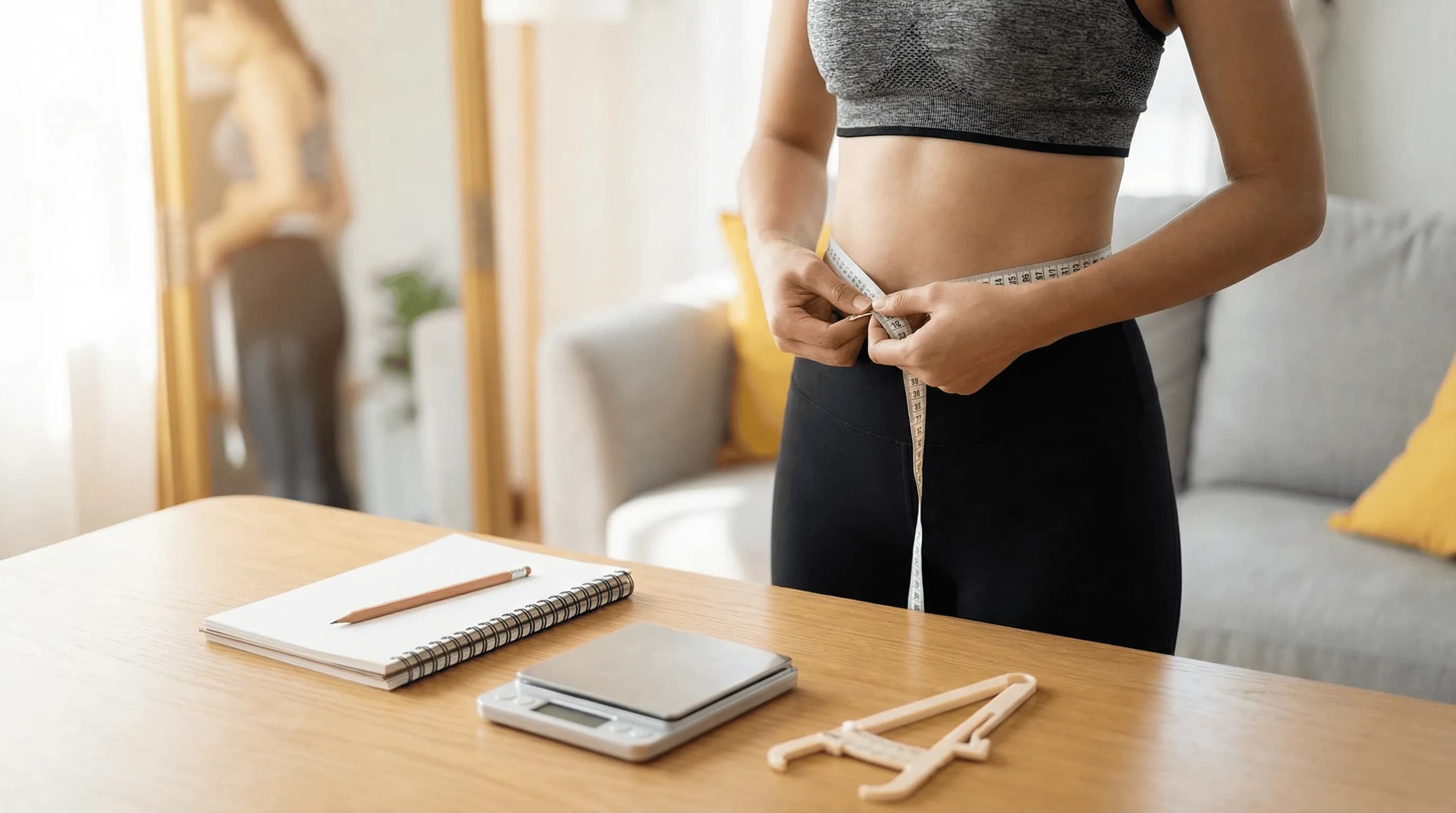
What body fat percentage actually means
Body fat percentage is a simple idea with an annoying reputation. In plain terms, it’s an estimate of how much of your total body mass comes from fat tissue, versus everything else—muscle, bone, organs, and water (often grouped together as “lean mass”).
If you weigh 80 kg and your body fat percentage is 20%, the claim is: roughly 16 kg is fat and 64 kg is lean mass. Not because someone secretly weighed your fat on a scale (rude), but because a method inferred it based on measurements, images, electrical impedance, or visual cues.
This guide walks through the major ways body fat is estimated, what each method is good (and bad) at, and how to make sense of the numbers without overreacting to short-term noise. By the end, you should have a clear mental model for estimating body fat — and for deciding which approach makes sense for your goals.
The important part: body fat % is a model, not a microscope.
Different methods use different signals, so two “good” methods can disagree. That’s normal. Your job isn’t to hunt the One True Number—it’s to use a method that helps you understand your body and track changes reliably.
Another reason it gets confusing: body fat percentage is just one number, but your body isn’t one number. Two people can both be “20%” and look wildly different depending on things like muscle mass, fat distribution, height, frame size, and genetics. (We’ll dig into that later, because it matters.)
Think of body fat percentage as a translation layer between what you see (shape, definition, softness) and what you can measure. When you use it well, it’s incredibly useful. When you treat it like lab-grade truth, it turns into a frustration machine.
The main ways to estimate body fat percentage
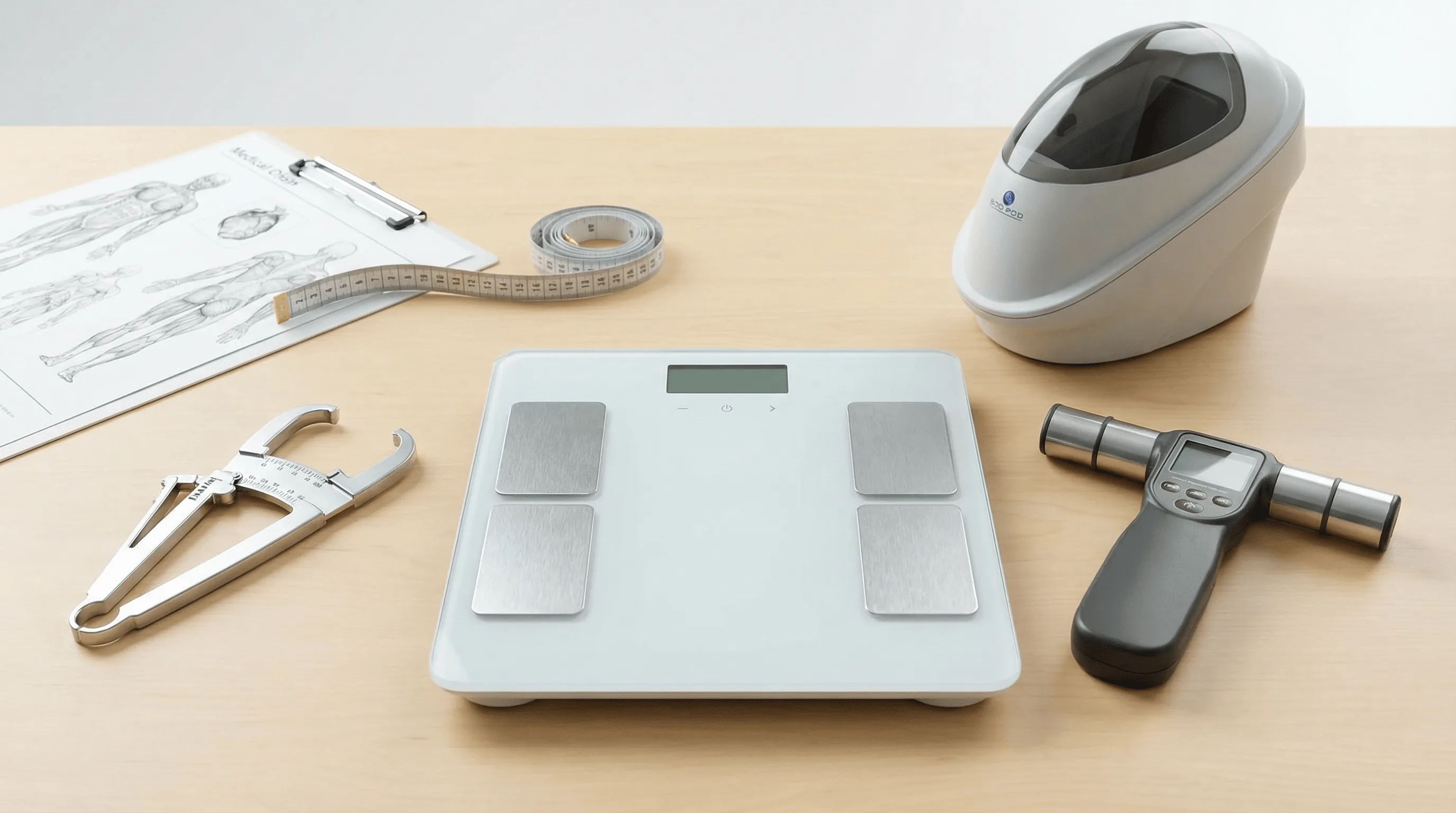
There isn’t one “body fat test.” There are several different ways toestimate body fat, each built around a different idea of what information best reflects what’s happening inside your body.
This is where a lot of confusion starts. People compare numbers from different methods as if they’re measuring the same thing in the same way. They’re not. Each method uses different signals, makes different assumptions, and answers slightly different questions.
A useful way to think about body fat estimation
Every method is trying to translate something observable into an estimate of fat mass. The difference is what it observes.
Broadly speaking, body fat estimation methods fall into a few categories. None of these are “right” or “wrong” by default — they’re just better or worse suited to different goals.
Visual estimation (appearance-based)
Visual estimation is the oldest and most intuitive method: looking at a body and comparing it to known examples or ranges. This can be done with comparison charts, photos, or experience-based judgment.
Humans are surprisingly good at this in a broad sense. We naturally notice changes in shape, definition, softness, and fat distribution — often before any number changes meaningfully.
The downside is subjectivity. Muscle mass, genetics, posture, and lighting can all influence how someone looks at a given body fat percentage. Visual estimation works best as a way to understand appearance, not to pin down an exact number.
AI photo-based estimation
AI photo estimation builds on visual assessment by using computer vision to analyze patterns across large numbers of bodies. Instead of relying on a single person’s judgment, the system evaluates proportions, silhouette, and fat distribution based on learned visual cues.
This approach doesn’t measure fat directly. Its strength is alignment with how people actually experience progress: through photos, mirrors, and changes in appearance over time.
Like all visual methods, consistency matters. When photos are taken under similar conditions, AI estimation can be especially useful for tracking trends rather than chasing a single precise value.
Formula-based calculators
Formula-based calculators estimate body fat using inputs like height, weight, age, sex, and sometimes circumference measurements. These formulas are derived from population averages.
Their biggest advantage is speed and accessibility. Their biggest limitation is assumption. If your body doesn’t resemble the “average” body the formula was built around — for example, if you carry more muscle or store fat differently — the estimate can drift.
Calculators are best treated as rough context, not definitive answers.
If you want a broader height-weight screening set, compare outputs from the overweight gap calculator, the ponderal index calculator, and the Broca index calculator. For dosing-style planning contexts, layer in the adjusted body weight calculator.
Measurement-based methods (tape, scales, scans)
Some methods rely on physical measurements or indirect signals from the body. These include tape measurements (like the Navy Method), smart scales that use electrical impedance, and lab-based scans such as DEXA.
These approaches feel more “scientific” because they involve numbers, devices, or imaging. In practice, they still rely on models and assumptions, and many are sensitive to factors like hydration, timing, and measurement technique.
Some are useful for occasional reference points. Fewer are practical for frequent, real-world tracking.
Why different body fat methods give different results
If you’ve ever compared two body fat estimates and wondered which one is “wrong,” this section is for you. Most of the time, neither method is broken — they’re just answering slightly different questions.
One method might be sensitive to water retention. Another might be biased by muscle mass. A third might reflect visual appearance more closely than internal composition. When you compare them directly, disagreement is not only possible — it’s expected.
The key takeaway
Body fat estimation isn’t about finding a single perfect number. It’s about choosing a method that matches your goal, understanding its limitations, and using it consistently enough to see real trends.
What does body fat percentage look like?
When most people think about body fat, they’re not thinking in formulas. They’re thinking in mirrors, photos, and how clothes fit. That’s why one of the most common questions people ask is some version of: “What does this body fat percentage actually look like?”
Visual references can be incredibly helpful for building intuition. They give you a rough sense of how body fat tends to show up at different levels: changes in definition, softness, waist shape, and overall proportions.
At the same time, visual comparison is where many people get tripped up. Bodies aren’t standardized. Two people at the same estimated body fat percentage can look very different depending on muscle mass, height, frame, and where they tend to store fat.
Use visual examples as context, not a verdict
Visual references are best used to understand ranges and patterns—not to force yourself into a specific number based on a single photo.
Common visual traits at different body fat ranges
The descriptions below are intentionally broad. They describe common patterns—not rules—and assume average muscle mass. Individual variation is normal and expected.
Around 10–12%
Clear muscle definition, visible separation, and minimal softness. Abdominal outlines are usually visible, and veins may be noticeable. This range often requires deliberate dieting or athletic conditioning and isn’t where most people naturally sit year-round.
Around 15%
Lean appearance with some visible definition, especially in good lighting or when flexed. The waist looks relatively tight, but there’s still a natural softness at rest. This is a common “lean but livable” range for many people.
Around 18–20%
A generally fit appearance without sharp definition. Muscle shape is visible, but outlines are smoother. The midsection may look flat in some positions and softer in others. This range often surprises people who expect higher numbers to look “worse” than they actually do.
Around 25%
Noticeable softness, particularly around the waist and hips. Muscle definition is limited without flexing. Clothing fit and body shape tend to change more noticeably with small fat gains or losses in this range.
30% and above
Higher overall softness with less visible muscle shape. Fat distribution varies widely by individual, which is why appearance can differ so much even within the same estimated range.
Why two people at the same body fat percentage can look completely different
This is one of the most important ideas to understand if you want body fat numbers to stop feeling confusing. Body fat percentage does not exist in isolation—it sits on top of your individual body structure.
- Muscle mass: More muscle changes shape dramatically at the same body fat percentage.
- Fat distribution: Some people store more fat centrally, others more evenly.
- Height and frame: The same amount of fat spreads differently on different frames.
- Genetics: Where you gain and lose fat first isn’t a choice—it’s biology.
This is why copying someone else’s target percentage rarely works. The more useful question isn’t “What body fat percentage should I be?” but rather “How is my body changing over time?”
Static images vs understanding your own body
Comparison charts and example photos are a great starting point. They help build intuition and correct unrealistic expectations. But they can only go so far.
Real progress is personal. Lighting, posture, muscle mass, and fat distribution all influence how you look. That’s why visual tools that let you compare your own photos over time tend to be more informative than trying to match yourself to a static example.
Visual estimation works best when it’s used as a way to understand patterns and trends—not to label yourself based on a single snapshot.
AI body fat estimation: what it actually does
AI body fat estimation doesn’t “measure” fat in the medical sense. There’s no scan, no electrical current, and no direct reading of tissue. Instead, it estimates body fat by analyzing how fat appears visually across thousands of real human bodies.
In simple terms, the system looks at proportions, silhouette, and fat distribution patterns — the same visual cues humans subconsciously use when judging whether someone looks lean, average, or soft.
The difference is scale and consistency. AI can compare a single photo against patterns learned from many thousands of labeled examples, applying the same criteria every time.
Important framing
AI body fat estimation produces an informed estimate based on appearance. It is not a medical test, diagnosis, or replacement for lab-based measurements.
Why photos are surprisingly informative
Fat changes how bodies look long before it dramatically changes scale weight. It alters waist shape, smooths muscle outlines, affects posture, and changes proportions between the upper body, midsection, and lower body.
This is why many people notice visual progress weeks before the scale reflects it — and why appearance-based estimation can be directionally useful even when exact precision isn’t possible.
Photos capture the thing most people actually care about: how their body looks in the real world. When taken under similar conditions, they become a surprisingly stable signal for tracking change.
What the AI pays attention to
While the exact model details aren’t visible to users, appearance-based estimation generally relies on patterns such as:
- Overall body silhouette and proportions
- Relative waist width compared to shoulders and hips
- Softness or definition around common fat storage areas
- Distribution patterns rather than isolated features
Crucially, the system looks at combinations of cues rather than any single feature in isolation. This helps reduce overreliance on things like abs, veins, or muscle separation alone.
What the AI deliberately ignores
Just as important as what the model uses is what it does notattempt to infer.
- Health status or medical risk
- Muscle strength or fitness level
- Internal fat, bone density, or organ composition
- Any personal identity or biometric identification
This keeps the system focused on its actual purpose: helping people interpret visible body composition changes without drifting into medical or diagnostic claims.
Why AI estimation works best for tracking change
AI body fat estimation is most useful when it’s treated as a consistent reference point rather than a one-time truth.
If you upload photos taken under similar conditions — similar lighting, posture, distance, and clothing — the estimate becomes a stable baseline. Changes over time are often more meaningful than the exact number itself.
This is the same principle that makes progress photos valuable. The AI simply adds structure and context to what your eyes are already noticing.
The right mental model
Think of AI body fat estimation as a visual ruler. It won’t tell you the “absolute truth” about your body — but it can help you see whether the needle is moving in the right direction.
How accurate are body fat estimates, really?
The uncomfortable truth is that no commonly available body fat method is perfectly accurate. Not calculators. Not smart scales. Not photos. Not even lab scans.
Every method estimates body fat indirectly, using assumptions and models. The differences you see between tools aren’t bugs — they’re the result of each method answering a slightly different question.
That’s why it’s more useful to think in terms of usefulnessrather than absolute accuracy.
Precision vs consistency (the distinction that matters)
Precision asks: “How close is this number to some theoretical true value?” Consistency asks: “If nothing changes, will I get roughly the same result again?”
For tracking progress, consistency matters far more than precision. A method that’s slightly biased but repeatable is usually more helpful than a method that’s theoretically precise but noisy or impractical.
A useful rule of thumb
If a method gives you similar results under similar conditions, it’s usable for tracking — even if the exact number isn’t “perfect.”
Why two body fat methods often disagree
Different methods rely on different signals:
- Formulas assume population averages
- Tape measurements infer fat from circumference
- BIA scales infer composition from electrical resistance
- Photos infer fat from visible distribution and proportions
Because these signals don’t change in lockstep, disagreement is normal. Hydration, recent food intake, muscle mass, posture, and lighting can all shift estimates without any real change in body fat.
Common sources of “noise” people mistake for fat change
Many short-term swings in body fat estimates have nothing to do with fat itself. Common sources of noise include:
- Water retention or dehydration
- Glycogen changes from diet or training
- Digestive contents
- Measurement technique differences
- Lighting, camera angle, or posture in photos
This is why daily checking often creates frustration. Fat changes slowly; noise changes quickly.
How to interpret body fat estimates without overreacting
The most reliable way to use any body fat estimation method is to zoom out. Single measurements are rarely meaningful on their own.
- Look at trends over weeks, not days
- Compare results under similar conditions
- Use one primary method instead of switching constantly
- Cross-check with visual changes and how clothes fit
When estimates move gradually in one direction and your appearance supports that change, you can be confident you’re seeing real progress.
Bottom line on accuracy
No method gives a perfect number. But a consistent method, interpreted with context, can be extremely useful. Accuracy improves when expectations are realistic.
The best body fat method depends on what you’re trying to do
Most frustration around body fat tracking comes from using the wrong tool for the job. People often ask, “Which method is best?” when the more useful question is, “Best for what?”
Estimating body fat can serve different purposes — understanding your appearance, tracking progress, or getting a rough reference point. No single method excels at all three.
If your goal is understanding how you look
If you care most about how lean or soft you appear — in the mirror, in photos, or in clothing — visual methods are often the most intuitive.
Body fat example charts and AI photo estimation both anchor numbers to appearance. They won’t tell you everything about your body, but they do a good job of answering the question most people actually have: “Where do I roughly sit?”
Best fit: visual examples and AI photo-based estimation.
If your goal is tracking progress over time
Progress tracking is less about absolute numbers and more about detecting direction. For this, repeatability matters far more than theoretical precision.
Methods that are easy to repeat under similar conditions — such as consistent photos, tape measurements, or the same smart scale routine — tend to work best.
Best fit: one consistent method used under similar conditions.
If your goal is a one-time reference or baseline
Sometimes you just want a rough snapshot — a starting point, a curiosity check, or a baseline before making changes.
In these cases, calculators, tape methods, or even a lab scan can be useful, as long as you understand their limitations and don’t overinterpret the result.
Best fit: calculators, tape measurements, or occasional scans.
A simple decision framework
If choosing still feels overwhelming, use this simple framework:
- Pick one primary method
- Use it under similar conditions each time
- Track changes over weeks, not days
- Cross-check with how you look and feel
This approach minimizes noise, reduces frustration, and keeps body fat estimation in its proper role: a tool for understanding, not something to obsess over.
The takeaway
The “best” body fat estimation method is the one that fits your goal, matches your lifestyle, and helps you make sense of change over time. Everything else is secondary.
A simple, realistic way to use body fat estimation
If you’ve read this far, you already understand more about body fat estimation than most people. The remaining step isn’t learning another method — it’s choosing a simple approach and actually using it consistently.
You don’t need to combine five tools, chase perfect accuracy, or check numbers daily. In practice, most people get the best results by pairing visual context with one repeatable estimate and giving changes enough time to show up.
A practical baseline approach
- Take a clear set of photos under simple, repeatable conditions
- Use the same estimation method each time
- Check progress every 1–2 weeks, not daily
- Focus on trends rather than individual readings
This keeps body fat estimation in its proper role: a tool for orientation and feedback, not a source of stress or false certainty.
How this site fits into that process
This site is built around three ideas:
- Understanding: clear explanations of what body fat percentages mean and why methods differ
- Visualization: examples that anchor numbers to real appearances
- Estimation: a consistent, appearance-aligned way to track change over time
You can use all three together, or just the pieces that matter most to you. There’s no single “right” workflow — only what helps you interpret your own body more clearly.
Body fat estimation doesn’t need to be mysterious or stressful. When used thoughtfully, it’s simply a way to understand change — not to judge it.
Pick a method. Stay consistent. Give it time. Everything else is noise.

 Body Fat Estimator