Body Fat Calculator vs Body Fat Estimator — What’s the Difference?

“Calculator” and “estimator” get used like they’re the same thing, but they’re not. And that tiny language mix-up is the reason so many people end up staring at three different numbers and thinking, Cool. Which one is lying?
Here’s the truth: most tools aren’t “wrong.” They’re just built to do different jobs. A calculator applies a formula. An estimator infers based on patterns (often visual patterns). When you understand that difference, the entire body fat universe becomes way less annoying.
Why this confusion exists
People search “body fat calculator” when what they actually want is an answer to one of these:
- How lean am I right now?
- Am I actually making progress?
- Why do different tools give different results?
- Does this number match how I look?
A calculator can sometimes help. But a lot of the time, what people want is a repeatable way to understand their appearance over time. That’s an estimator’s job.
Quick translation
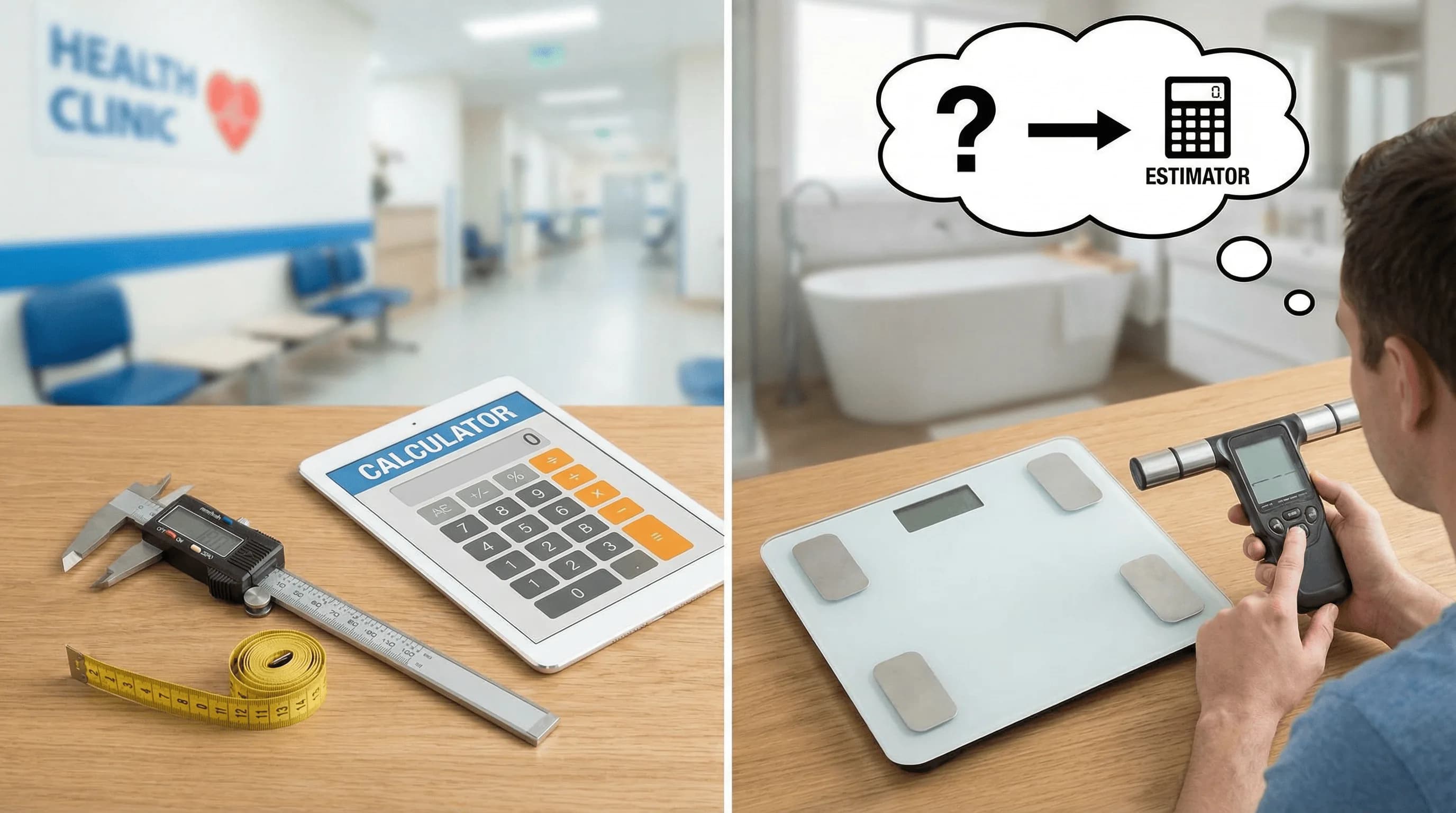
Calculator: “Given these inputs, what does the formula say?”
Estimator: “Based on patterns, what does this body most closely resemble?”
What a body fat calculator actually is
A body fat calculator is a tool that takes a set of inputs and produces an output using a fixed formula.
That means if you enter the same inputs today, tomorrow, and next week, you get the same result—because the math is deterministic. It’s not “learning.” It’s not “inferring.” It’s calculating.
Common examples
- The Navy Method (tape measurements + formula)
- Height/weight/age/sex calculators derived from population studies
- Some “body fat % calculators” that ask for circumferences (waist, neck, hips)
What calculators are good at
- Fast and simple
- Cheap (often free)
- Repeatable math
- Good for a rough baseline if measured consistently
Where calculators break down
The catch: calculators are built on assumptions. Most formulas are derived from population averages. If your body differs from the “average” body the formula was designed around, your result can drift.
- Very muscular people often get estimates that don’t match their appearance
- Fat distribution varies (two waists can measure the same but look different)
- Small tape errors can swing results more than actual fat changes
The calculator mental model
A calculator is like a recipe: inputs go in, output comes out. Useful—but it can’t “see” you.
What a body fat estimator actually is
A body fat estimator doesn’t apply a single fixed formula. It produces an estimate by inferring body fat from indirect signals.
In other words: it doesn’t say “given X and Y, the answer must be Z.” It says “based on patterns and signals, the most likely range is…”
Common examples
- Visual comparison charts
- Coach-style visual assessments
- AI photo estimation (computer vision analyzing proportions and fat distribution)
What estimators are good at
- Better alignment with appearance
- Better for tracking visible change over time
- More flexible for non-average body types
- Often more “useful” in the real world, even if not perfect
Where estimators break down
Estimators have a different weakness: they depend heavily on consistency. Visual methods are sensitive to lighting, pose, and camera angle. AI estimation is the same: it becomes powerful when your setup is repeatable.
The estimator mental model
An estimator is like a weather forecast: it’s a best-fit inference based on patterns. Not an oracle—but extremely useful if you interpret it correctly.
Why calculators and estimators give different results
The simplest explanation is also the most important: they’re using different signals.
- Calculators infer fat from measurements and formulas (often designed from population averages).
- Estimators infer fat from appearance patterns (or other indirect cues).
Those signals don’t always change together. Water retention can change waist measurements. Lighting can change perceived definition. Muscle mass can “hack” formulas. And suddenly your tools disagree.
Key takeaway
Disagreement between tools usually isn’t failure. It’s the expected outcome of using different models.
Calculator vs estimator: quick comparison
- What it uses: Calculator → formulas and inputs • Estimator → patterns and indirect signals (often visual)
- Best for: Calculator → rough baseline • Estimator → progress tracking and appearance alignment
- One-time precision: Calculator → moderate • Estimator → moderate (range-based)
- Tracking over time: Calculator → depends on measurement consistency • Estimator → strong when setup is consistent
- Common failure mode: Calculator → “I’m muscular, so the number feels off” • Estimator → “my photo setup changes”
Which one should you use?
“Better” depends on what you’re trying to do. Here’s the cleanest decision rule:
- If you want a quick rough number for context → calculator
- If you want to understand how you look → estimator
- If you want to track progress reliably at home → estimator (with consistent photos)
- If you want a one-time high-confidence snapshot → consider a scan (DEXA) as a reference point
Most people accidentally use a calculator for an estimator problem. That’s how you end up “stuck at 18%” while your photos are clearly changing.
Where AI body fat estimation fits in
AI photo tools are a modern version of visual estimation: they infer body fat based on appearance patterns like proportions, silhouette, and fat distribution.
That makes them especially useful for the most common real-world job: tracking changes in how your body looks over time.
If you want the deeper explanation, here are the two most useful next reads:
The mistake most people make
The classic failure mode is tool-hopping. You use a calculator on Monday, a smart scale on Tuesday, an AI estimator on Friday, and then you average the numbers like you’re doing taxes.
All that does is average the confusion.
A calmer approach
Pick one primary method for tracking. Use it consistently. Judge progress by trends over weeks—not by single readings.
A simple way to use both (without losing your mind)
The best “hybrid” approach is boring—in the best way:
- Use one calculator method as occasional context (monthly or quarterly)
- Use one estimator method for weekly/biweekly tracking (photos + consistency)
- Compare trends, not absolute numbers across tools
The win condition isn’t a perfect percentage. The win condition is understanding what’s changing—and staying consistent long enough to see it.