Jawline Check & Gonial Angle Calculator
Upload a side-profile photo to measure your gonial angle in degrees and classify your jawline type.
drop a photo here,
By uploading a photo, you agree to our Terms of Service. To learn more about how bodyfatestimator.ai handles your personal data, check our Privacy Policy.
Your Jawline (Gonial) Angle
The highlighted row marks your current jawline type band from manual point placement.
| Angle Range (deg) | Jawline Type |
|---|---|
| ≤90 | Blockish (Not Desired) Very low mandibular angle. This bucket is treated as a non-desired/blockish profile zone. |
| 91-114 | Very Sharp Very acute mandibular angle with a strong posterior-to-anterior jawline transition. |
| 115-124 | Sharp Defined angle with clear contour separation near the gonial region. |
| 125-134 | Balanced Middle-range angle often seen when jawline definition is present without extreme angularity. |
| 135-145 | Soft Obtuser mandibular angle with smoother contour transition from ramus to chin. |
| 146-170 | Rounded Broad, obtuse jawline angle with less abrupt angular definition in profile. |
How Jawline Check Measures Angle
This tool measures the side-profile mandibular angle at gonion using three landmarks: one point along the posterior ramus line, the gonial corner, and a chin-edge point near menton. The interior angle between these two segments is used to classify jawline type.
The primary workflow is user-set geometry, so you can correct landmark placement directly. Auto-detect is optional and meant as a starting point.
Want a Sharper Jawline? Train it Daily.
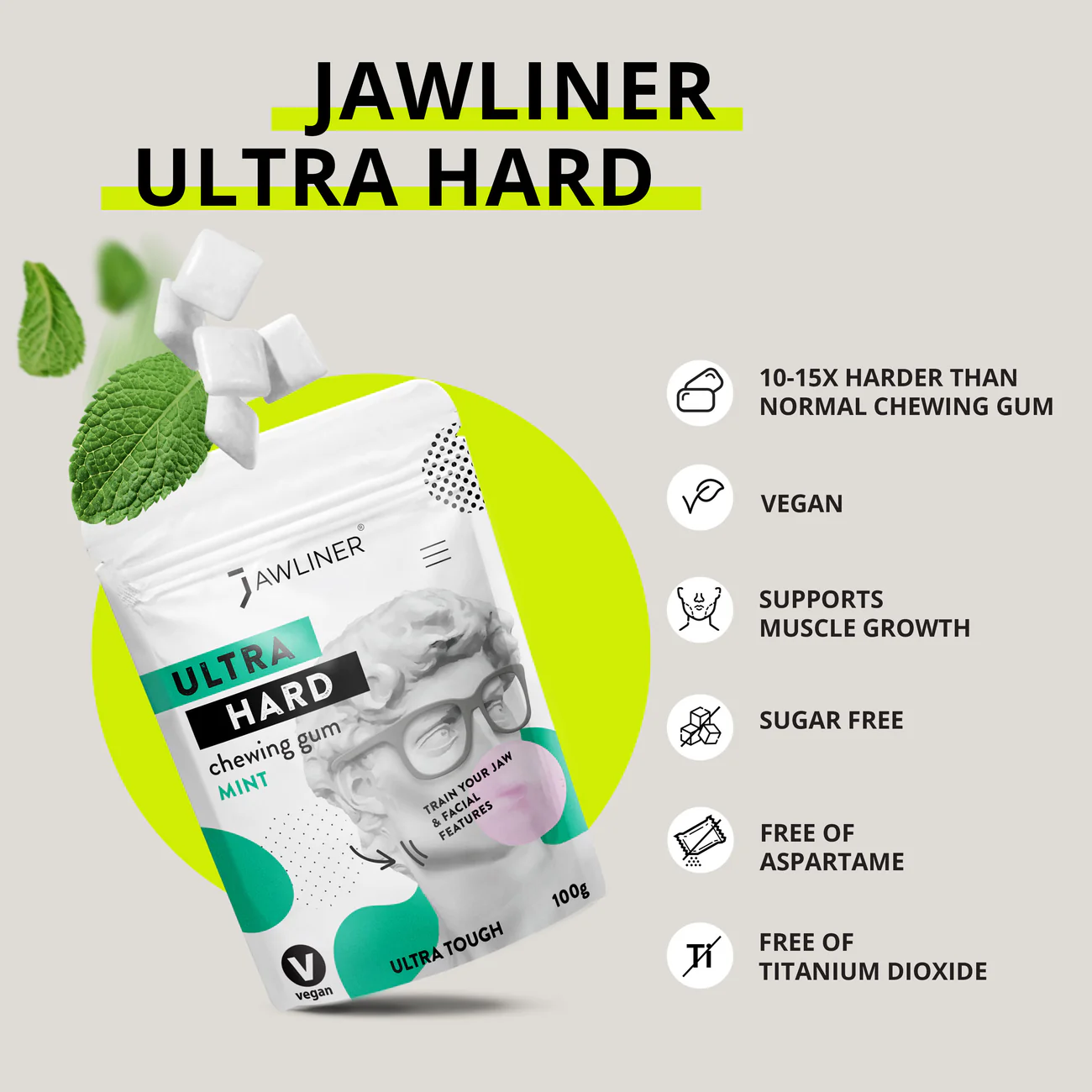
You are already tracking your jawline angle here. Pair that progress with Jawliner and turn quick daily sessions into a stronger, more defined profile over time.
FAQs
Common questions about jawline angle estimation, landmark placement, and result consistency.
- Use a true side profile (around 90 degrees), not a three-quarter angle.
- Keep head posture neutral without chin tuck or extension.
- Use even lighting with minimal shadows across jaw contour.
- Keep hair, beard bulk, and clothing away from the jawline edge.
- Use a true side profile (about 90 degrees) instead of a three-quarter angle.
- Keep your head neutral without chin tuck or neck extension.
- Use even lighting; avoid deep shadows under the jaw border.
- Pull hair, beard bulk, scarves, or collars away from the jawline edge.
- Use normal camera distance to reduce perspective distortion.
This is an appearance-based estimate from one photo and manual landmark placement. It is sensitive to camera perspective, occlusion, beard density, posture, and image quality.
It does not replace clinical cephalometric assessment or medical evaluation.
The overlay dots represent user-controlled landmarks. Dashed lines indicate the posterior mandibular segment and mandibular body segment used to estimate the angle.
Small point shifts can materially change angle output. Zoom in visually, place points carefully, and keep your method consistent if you are tracking over time.
References
- Upadhyay RB, Upadhyay J, Agrawal P, Rao NN. Analysis of gonial angle in relation to age, gender and dentition status by radiological and anthropometric methods.PubMed record
- Sforza C, Grandi G, Catti F, et al. Age- and sex-related changes in three-dimensional facial morphology.PubMed record
- Farkas LG, Katic MJ, Forrest CR. International anthropometric study of facial morphology in various ethnic groups/races.PubMed record
- Kazemi V, Sullivan J. One millisecond face alignment with an ensemble of regression trees.arXiv paper
 Body Fat Estimator