What Does Body Fat Percentage Look Like?

If you’ve ever wondered “What does 15% look like?” or “Am I closer to 20%?”, you’re asking the right question. Most people experience body fat through appearance—how lean or soft they look—not through formulas.
This guide gives realistic visual descriptions for common body fat ranges and explains why the same % can look different across people.
First: treat body fat as a range, not a single number
Visual estimates are best interpreted as a range (for example, 15–18%) rather than a single precise number. That’s because appearance depends on more than body fat percentage alone.
The biggest “appearance modifiers” are muscle mass, fat distribution, height/frame size, and how/where you store fat. Keep those in mind as you read the examples below.
Want a faster shortcut than scrolling?
What does 10% body fat look like?
At around 10% body fat, most people look visibly lean in almost any lighting. In men, the midsection tends to look flat with clear abdominal definition. In women, the waist and midsection look tight, with visible definition in the lower body depending on muscle mass.
This range often looks “athletic lean” to “photo-ready” depending on muscle. If someone has low muscle mass, they may look lean but not particularly defined.
Reality check: lighting, pump, and posing can make 10–12% look like 8–10% in photos.
What does 12% body fat look like?
Around 12%, most people look clearly lean day-to-day. In men, abs are often visible without flexing, but definition may vary depending on muscle and genetics. In women, legs and glutes often show definition, and the waist looks noticeably tight.
This range tends to be sustainable for many active people compared with lower single digits. It’s common for “lean but not shredded” physiques to live around 10–14%.
Muscle mass matters: 12% on a muscular frame can look dramatically leaner than 12% on a lighter frame.
What does 15% body fat look like?
Around 15% body fat is where many people start asking “Am I lean?” because the answer becomes lighting-dependent. In men, you may see some ab lines, but not consistently. The midsection looks fairly flat, but a relaxed posture can look softer. In women, the waist appears defined, but lower-body softness varies with fat distribution.
This range is often a sweet spot: lean enough to look athletic, flexible enough to maintain without extreme dieting.
Common trap: if you’re comparing yourself to social media photos, you’ll often underestimate your body fat by 2–5%.
What does 18% body fat look like?
Around 18%, most people look healthy and “normal lean” rather than shredded. In men, ab definition is usually minimal unless flexed, and the lower stomach may look a bit soft. In women, the waist can still look relatively defined, but softness is more noticeable in hips, thighs, and lower body depending on genetics.
Many people who train casually sit around this range. It’s also a place where improvements show quickly because small changes start to become visible in the mirror.
If you carry fat primarily in the midsection, 18% can look closer to 20%—distribution matters.
What does 20% body fat look like?
Around 20%, many people look “average” with a noticeable softness in the midsection. In men, abs are typically not visible, and the waist may look a bit thicker. In women, curves are often pronounced, but definition is limited unless muscle mass is high.
This range can still look very good—especially with strong posture and decent muscle. But it’s usually where people feel “softer” in photos compared with how they feel in real life.
Photo effect: overhead lighting and relaxed posture often makes ~20% look closer to ~22–25%.
What does 25% body fat look like?
Around 25%, softness becomes the dominant visual trait. In men, the midsection is typically rounded with little visible definition. In women, curves may be more pronounced, and fat storage in the lower body is common, though distribution varies widely.
This range is also where muscle mass can dramatically change how someone looks. With higher muscle, 25% can look like “strong with softness.” With lower muscle, it can look less structured.
Important: this guide is about appearance—not worth, health, or performance. People function, train, and live across a wide range of body fat levels.
What does 30%+ body fat look like?
At 30% and above, body fat tends to dominate shape and silhouette. Definition is minimal, and softness appears across the midsection, limbs, and face depending on where you store fat.
The biggest takeaway here is not the exact number—it’s that visual estimation becomes harder because distribution differences widen. Two people at 30% can look very different depending on height, frame, muscle mass, and fat storage patterns.
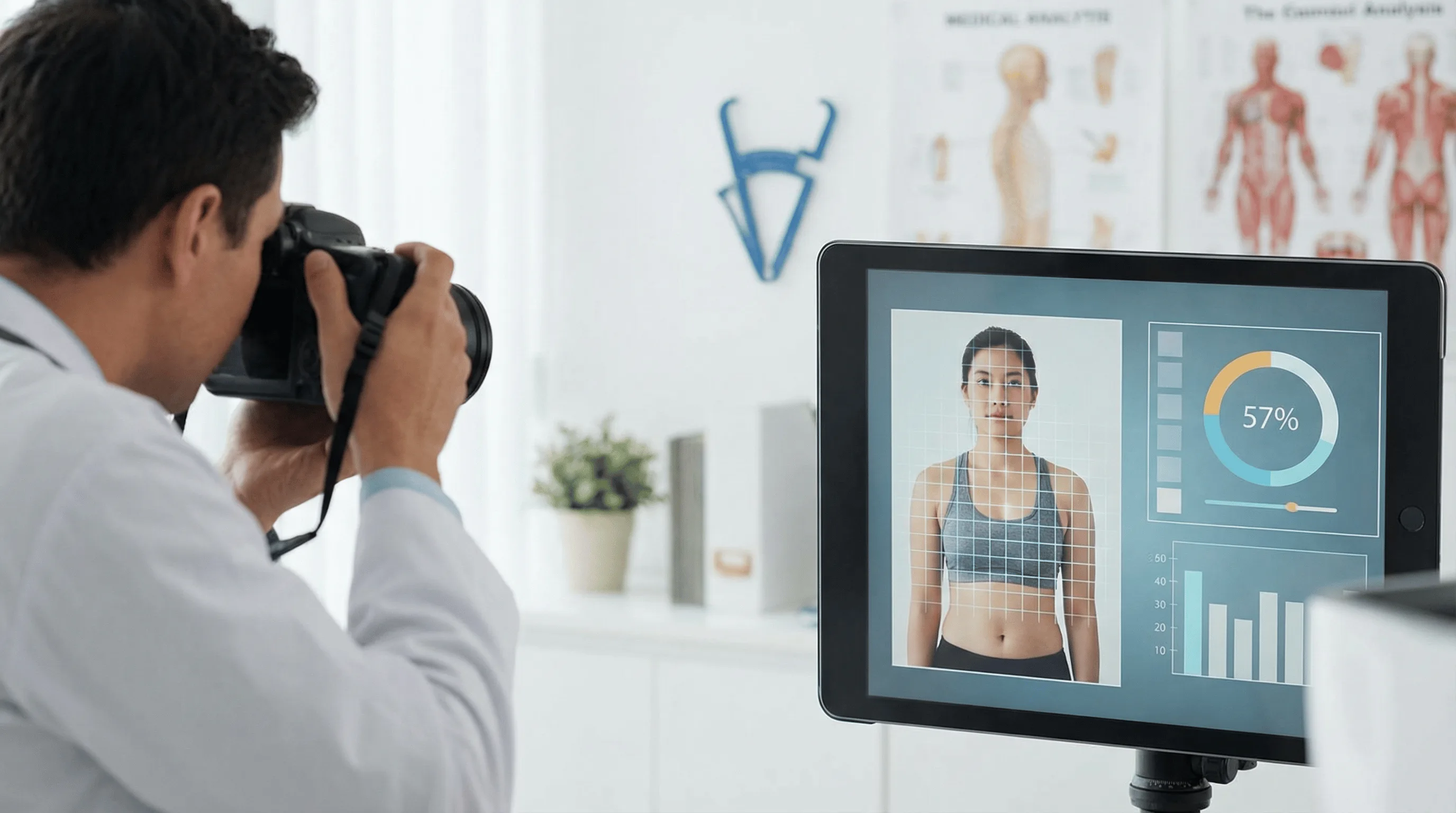
If you want a personal estimate rather than a generic chart, use a consistent photo setup for a more individualized result.
The best way to use visual estimates
A visual guide is best used to narrow yourself into a range. Then use a repeatable method to track change over time. For most people, the simplest repeatable approach is consistent photos.
- Use the same lighting and camera distance
- Use the same pose (front + side is enough)
- Track changes over weeks, not days
- Interpret your % as a range (e.g., 18–20%)